Part 8: Egypt as Memory, Not Just History
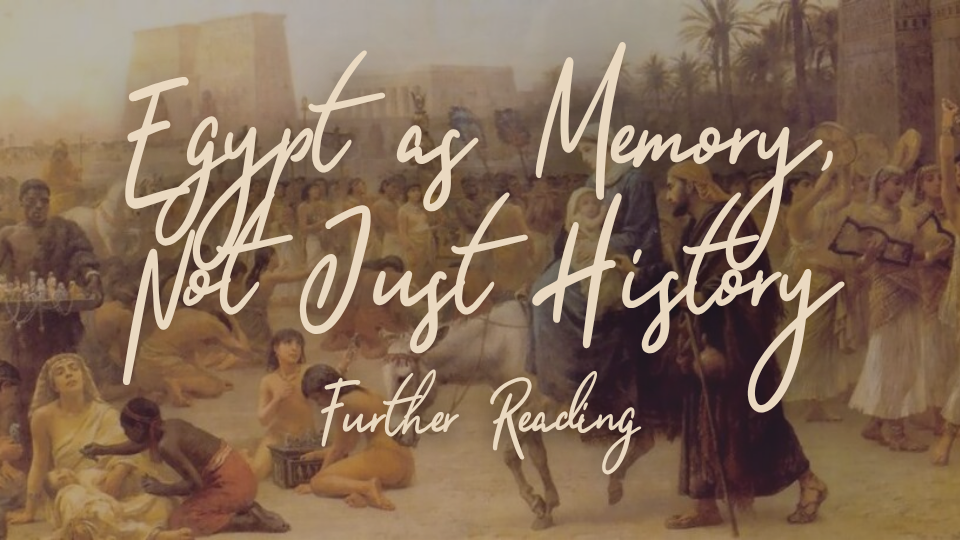
Part 8: Egypt as Memory, Not Just History
Pairs with: Part 8 of the Egypt and the Bible Series from You've Heard It Said: How to Outlast an Empire
This "further reading" is designed to make your Bible reading come alive. There are no set days or obligations to read consecutively, so engage at your own pace. Some installments will be longer than others depending on the theme. The hope is that these curated spotlight passages will illuminate Egypt through the biblical lens, helping the stories you thought we knew take on new depth and meaning.
Scripture:
- Jeremiah 43:1–7; 44:1
- Matthew 2:13–23
- Hosea 11:1
- Isaiah 19:19–25
- Genesis 12:1–3
Cultural Note:
By the time Mary and Joseph fled to Egypt with the infant Jesus, Egypt had already been the Hebrew Bible's go-to refuge for nearly two thousand years. Abraham went down during famine. Joseph was sold there. Solomon married into its royal family. Jeroboam fled there for political asylum. Uriah the prophet ran there to escape Jehoiakim's death warrant. After Babylon destroyed Jerusalem in 586 BC, a group of Jewish refugees fled south and joined Jewish settlements that were already there. In settlements that would grow, by the time of Jesus, into one of the largest Jewish populations of any city outside Judea.
It was in Egypt, specifically in Alexandria, that Jewish scholars translated the Hebrew Bible into Greek between roughly 250 and 130 BC. That translation, called the Septuagint, became the Bible of the early church. When the New Testament writers quote the Old Testament, they are most often quoting the Septuagint. When Matthew quotes "Out of Egypt I called my son," he is quoting it from a translation made in Egypt, by Jewish people living in Egypt, almost three centuries before he picked up his pen. The land Israel sang about escaping is the land that gave the church its Bible.
This is what makes Matthew 2 so striking. Egypt, once the house of slavery, the empire of Pharaoh, the villain of Israel's foundational story, becomes the place that shelters the Messiah. The pattern reverses. The villain becomes the refuge. And by the second century, Christians were carving crosses into temples once dedicated to Egyptian gods. By the fourth century, an Egyptian named Athanasius was at the Council of Nicaea, defending the divinity of an Egyptian-language refugee child who had once hidden from a king in a cave near Cairo.
Centuries earlier, Isaiah had seen something like this coming. In Isaiah 19, God calls Egypt "my people" and Assyria "the work of my hands"—alongside Israel "my inheritance." Three nations, one blessing. It sounds an awful lot like Genesis 12:3, where God promised Abraham that all the families of the earth would be blessed through him. Egypt, in the end, doesn't just survive the biblical story. Egypt participates in it.
Reflection:
What "Egypts" do you carry? Places, seasons, or systems you came out of and feel you should leave behind? How does it change your reading of those places to know that God can turn a place of bondage into a place of refuge? Where in your life have you seen the villain of your story become the unlikely setting for grace?
And one bigger question: how is God calling you to remember faithfully—not romanticizing what was hard, not pretending the wounds didn't happen, but carrying the story forward in a way that lets God keep using it?
Conclusion
If you found this Further Reading Plan helpful, let me know in the comments on Substack or over on social media! I'd love to hear how you're engaging with Scripture through this historical and anthropological lens.