Part 5: Joseph—The Cost of Belonging
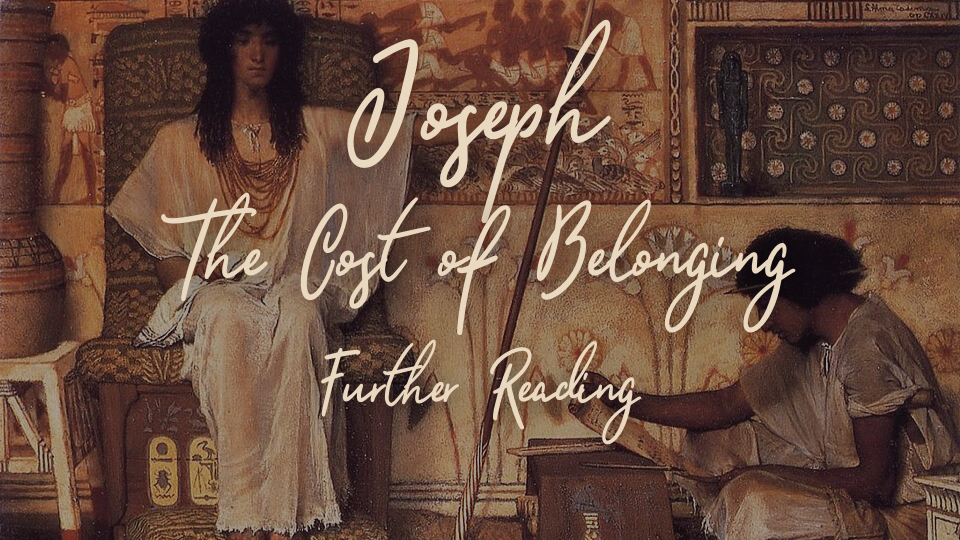
Part 5: The Cost of Belonging
Pairs with: Part 5 of the Egypt and the Bible Series from You've Heard It Said: Joseph—The Cost of Belonging
This "further reading" is designed to make your Bible reading come alive. There are no set days or obligations to read consecutively, so engage at your own pace. Some installments will be longer than others depending on the theme. The hope is that these curated spotlight passages will illuminate Egypt through the biblical lens, helping the stories you thought we knew take on new depth and meaning.
Scripture:
- Genesis 41:37–45—Joseph given an Egyptian name, an Egyptian wife, and authority over all of Egypt
- Genesis 41:50–52—The birth and naming of Manasseh and Ephraim
- Genesis 42:1–24—Joseph's brothers arrive; the interpreter detail
- Genesis 45:1–15—Joseph reveals himself
- Genesis 47:13–26—Joseph's agrarian reforms
- Acts 7:9–16—Stephen retells Joseph's story
Cultural Note:
By the time Joseph names his sons, he has been Egyptian for years—in title, in dress, in language, in marriage. Manasseh: God has made me forget. Ephraim: God has made me fruitful in the land of my suffering. These read like a man who has made peace with the distance.
Then Genesis 45 happens. His brothers are standing in front of him, and Joseph weeps so loudly that the Egyptians in the next room hear it. The Hebrew word used is not polite crying—it's wailing. Whatever forgetting he had managed, it wasn't that deep.
Centuries later, Stephen stands before the Sanhedrin in Acts 7 and retells this story as a pattern, not just a biography. The one God chose gets rejected by his own people, ends up in a foreign land, and ultimately becomes the means of their rescue—without them even recognizing him at first. Stephen's audience knew exactly where he was going with that. Joseph's story wasn't just history, it was a template.
What's striking is that Genesis holds both things without resolving them: the man who named his son forget, and the man who couldn't stop crying when his family walked into the room. Belonging to Egypt didn't erase what he came from. It just made the distance more complicated to carry.
Reflection:
On Assimilation and Identity: Joseph changed his name, his clothes, his language, his social world. Some of that was imposed; some of it he embraced because it was necessary for survival. Where have you had to adapt to belong somewhere—a workplace, a family system, a community? What did you gain, and what did the adaptation cost you? Is there a difference between healthy flexibility and losing yourself, and how do you know when you've crossed the line?
On Naming What You've Lost: Manasseh's name is striking in its honesty: God has made me forget my father's household. Joseph doesn't dress it up. He doesn't call it "moving forward" or "embracing the new." He calls it forgetting. What have you named as forgotten that might be worth sitting with more honestly? Are there losses you've framed as survival that still carry grief underneath?
On Faithfulness Inside Broken Systems: Joseph works faithfully within a system that eventually causes enormous harm, not because he intends harm, but because the system outlasts his intentions. He names God clearly (Genesis 41:16, 39:9, 40:8) and does his job with integrity. And yet the machine he builds gets used for purposes he didn't design. How do we hold faithfulness and complicity together? Can you be faithful to God while participating in extractive or unjust systems? Where are you navigating that tension in your own life?
On the God Who Credits Fruitfulness: When Jacob blesses Joseph's sons in Genesis 48, he crosses his hands to put Ephraim—the one named for fruitfulness in the land of suffering—above Manasseh, the one named for forgetting. The text quietly honors fruitfulness over forgetting. Is there a place in your own story where God has brought fruitfulness out of suffering? Something you might have named "the land of your affliction"?
On Providence and Survival: In Genesis 45, Joseph tells his brothers: "God sent me ahead of you." He frames his entire story through the lens of divine providence. That's a beautiful and theologically rich reading of his own life. But sit with the complexity: Joseph was also betrayed, enslaved, falsely accused, and imprisoned. Providence doesn't make those things less real. How do you hold together the truth that God works through suffering without using providence as a way to bypass the grief?
Further Reading:
- Read the full Joseph narrative from beginning to end (Genesis 37–50) in one sitting if you can. It reads like a novella, and the arc lands differently when you don't have chapter breaks interrupting it.
- Compare Joseph's story to Daniel 1 — another Hebrew man given a new name, absorbed into a foreign court, navigating faithfulness inside empire. Notice what's similar and what's different.
- Read Psalm 105:16–22, which retells Joseph's story in poetry form. What does the poet emphasize? What does he leave out?
- For the theme of God working through what seems like abandonment, sit with Romans 8:28 alongside Genesis 50:20 — and notice how differently Paul and Joseph frame the same theological idea.
Prayer Prompt:
God of Joseph,
You know what it is to be in a place where you don't quite belong. Where what you've built doesn't stay yours to control. Where survival has cost something you can't fully name.
Thank You that You are the God of Manasseh and Ephraim—the God of forgetting and fruitfulness, the God who meets us in the land of our suffering and calls it something. Not nothing. Not wasted.
Where I have adapted to belong, show me what I've carried faithfully and what I've quietly let go that I shouldn't have. Where I participate in systems that cause harm I can't fully see, give me honesty and wisdom and the courage to do what I can without pretending I can do more. Where I have framed loss as "moving on," let me grieve what it actually cost.
And in the places that still feel like the land of my affliction—help me trust that fruitfulness is still possible. That the story isn't over. That You are still sending things ahead.
Amen.
Conclusion
If you found this Further Reading Plan helpful, let me know in the comments on Substack or over on social media! I'd love to hear how you're engaging with Scripture through this historical and anthropological lens.
Next time:
We're moving into Goshen—the borderlands where most of Joseph's family actually lived, far from the court and its protections. When a new king rose who didn't want to remember what Joseph had done, all of his careful navigation couldn't protect them. How did Egypt go from welcoming Joseph's family to enslaving them? And what does "a new king arose who knew not Joseph" actually mean—politically, institutionally, and theologically?
That's Part 6: Goshen and the Politics of Forgetting.