Part 3: Gods of Order and Judgment
Part 3: Gods of Order and Judgment
Pairs with: Part 3 of the Egypt and the Bible Series from You've Heard It Said: Gods, Pharaohs, and Cosmic Order
This "further reading" is designed to make your Bible reading come alive. There are no set days or obligations to read consecutively, so engage at your own pace. Some installments will be longer than others depending on the theme. The hope is that these curated spotlight passages will illuminate Egypt through the biblical lens, helping the stories you thought we knew take on new depth and meaning.
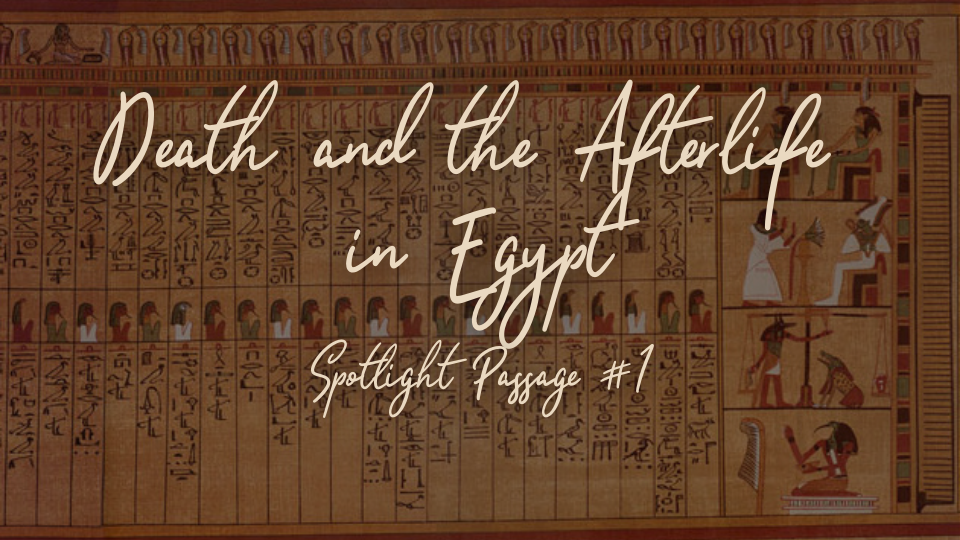
Book of the Dead papyrus (detail). New Kingdom Egypt. Photograph used under Canva Pro license. (Text overlays and notations mine).
Spotlight Passage 1: Death and the Afterlife in Egypt
Scripture Focus:
- Ecclesiastes 9:4-6 – "For the living know that they will die, but the dead know nothing... their love and their hate and their envy have already perished."
- Psalm 49:7-15 – "No one can redeem the life of another or give to God a ransom for them... But God will redeem me from the realm of the dead; he will surely take me to himself."
- John 11:25-26 – Jesus said to her, "I am the resurrection and the life. The one who believes in me will live, even though they die; and whoever lives by believing in me will never die."
Historical Deep-Dive:
Egyptians didn't just believe in an afterlife—they were obsessed with it. And this wasn't morbid fascination. It was Ma'at extended beyond death. If cosmic order could be maintained in this life through ritual, hierarchy, and divine mediation, then it could be maintained in the next life too. Death wasn't the end of order. It was a transition into a different kind of existence, but only if you prepared correctly.
Mummification was the most visible expression of this. When someone died—especially someone wealthy or royal—priests removed the internal organs (except the heart, which would be weighed in judgment), preserved the body with natron salt, wrapped it in linen, and placed it in elaborate coffins. The goal wasn't just preservation. It was transformation. The body had to be kept intact so the ka (life force) and ba (personality/soul) could reunite with it in the afterlife.
The process could take 70 days. It was expensive, precise, sacred. Professional embalmers worked in workshops near cemeteries. Priests recited spells at every stage. The body was anointed with oils, adorned with amulets, wrapped with prayers written on the linen itself.
The Book of the Dead wasn't actually a single book, but a collection of spells, hymns, and instructions for navigating the afterlife. These texts were written on papyrus scrolls and placed in the tomb, or painted directly on coffin walls and tomb chambers. They told the deceased how to avoid dangers in the underworld, how to answer questions posed by various gods, how to pass through gates guarded by demons, how to reach the Hall of Judgment where Osiris waited.
The most famous scene from the Book of the Dead is the weighing of the heart. The deceased stands before Osiris while Anubis places their heart on one side of a scale and Ma'at's feather on the other. Thoth records the result. If the heart is heavier than the feather—weighed down by lies, violence, chaos, injustice—the demon Ammit devours it. The person ceases to exist. But if the heart balances with the feather, the deceased is declared "justified" and can enter the Field of Reeds—an idealized version of Egypt where the Nile always floods, crops always grow, and Ma'at reigns forever.
Even in death, you were judged by whether you upheld Ma'at.
Tombs themselves were architectural marvels. The pyramids are the most famous, but even non-royal tombs were elaborate. Walls covered in paintings showing the deceased enjoying eternal life—feasting, hunting, sailing on the Nile, surrounded by family. These weren't just decorations. Egyptians believed the images had power. If you painted yourself harvesting grain in the afterlife, you would actually harvest grain. If you painted servants preparing food, those servants would serve you forever.
Tombs were stocked with grave goods—furniture, jewelry, food, tools, weapons, even model boats and servants (later replaced with shabti figurines—little statues that would magically come to life and do labor for you in the afterlife. Ideal right?). The wealthier you were, the more elaborate your tomb. Pharaohs' tombs were cities of the dead—vast complexes designed to ensure eternal life in perfect cosmic order.
But here's what's crucial: all of this—mummification, Book of the Dead, tomb paintings, shabti figurines—reinforced the central Egyptian belief that order can be maintained forever if you follow the right rituals.
Death wasn't chaos. It was just another realm where Ma'at applied. And if you prepared correctly, honored the gods, lived justly, and had the resources to purchase the right funerary package, you could continue existing in cosmic order forever.
For the Hebrews, this would have been both fascinating and oppressive. Your enslavers aren't just confident in this life—they're confident they've figured out how to maintain order beyond death. They're not hoping for an afterlife. They're engineering it with the same bureaucratic precision they use to run the empire.
And once again, the evidence seemed to support them. The tombs stood and their rituals had been working for thousands of years. Even in death, Egypt's system delivered.
Reflect:
- What does Egypt's approach reveal about human control vs. divine sovereignty? Egypt said: "Do these rituals correctly, purchase these amulets, prepare your tomb properly, and you can control your afterlife destiny." The Hebrew Scriptures said: "You can't redeem yourself. Only God can" (Psalm 49:7-8, 15).
- How does Jesus' resurrection reframe the entire conversation about death and afterlife? Egypt tried to preserve the body to maintain cosmic order beyond death. Jesus rose from the dead, defeating death itself. Egypt said eternal life comes through human preparation and ritual precision. Jesus said, "I am the resurrection and the life" (John 11:25), eternal life comes through relationship with Him, not ritual performance.
- Where in your life are you trying to "engineer" security, order, or outcomes through your own preparation and control, rather than trusting God's sovereignty?
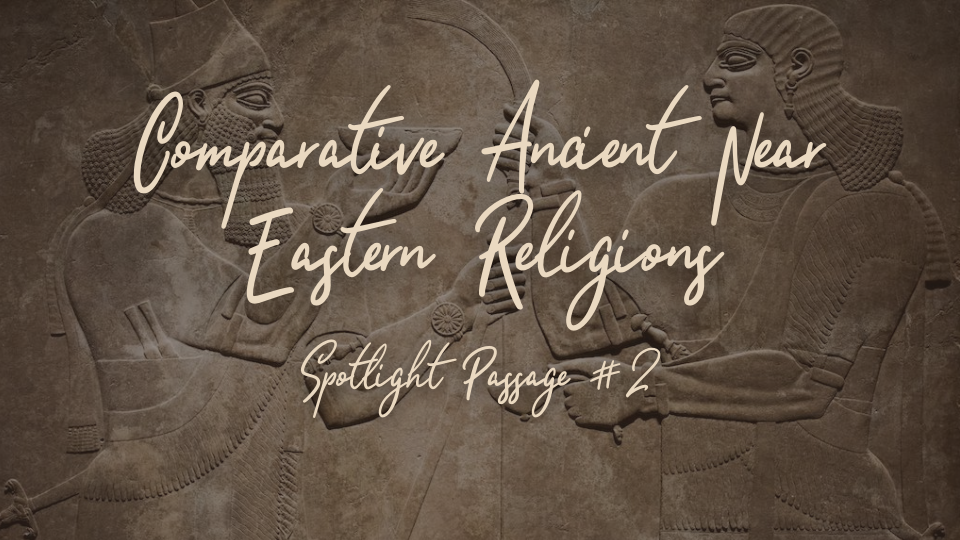
Ancient Near Eastern palace relief depicting royal figures. Neo-Assyrian or Achaemenid Persian period. Photograph used under Canva Pro license. (Text overlays and notations mine)
Spotlight Passage 2: Comparative Ancient Near Eastern Religions
Scripture Focus:
- Deuteronomy 6:4-5 – "Hear, O Israel: The LORD our God, the LORD is one. Love the LORD your God with all your heart and with all your soul and with all your strength."
- 1 Kings 18:20-40 – Elijah vs. the prophets of Baal on Mount Carmel
- Isaiah 44:6-20 – God mocking idols: "Half of it he burns in the fire... from the rest he makes a god, his idol; he bows down to it and worships."
Historical Deep-Dive:
I hope you don't mind this little detour, but I like to get my geographical and cultural bearings when trying to understand not only Scripture, but history as well. Let's take a look at the religious beliefs of the neighboring nations to ancient Israel.
The ancient Near East was religiously diverse. Every nation had its gods, its temples, and its rituals. But not all polytheism looked the same. Egypt, Mesopotamia, and Canaan each developed distinct theological systems—and Israel's monotheism stood in stark contrast to all of them.
Egypt offered cosmic order. Ma'at. Stability. Permanence. The gods were powerful, but they were also predictable. Follow the rituals, maintain the hierarchy, trust Pharaoh's divine mediation, and the cosmic machinery will keep running. Egypt's confidence came from the fact that their system worked with their advantageous Nile and reliable harvest. The empire endured for millennia. Egyptian religion wasn't desperate hope, it was engineered certainty.
Mesopotamia offered cosmic pessimism. The gods were capricious, fighting among themselves, using humans as pawns in their divine politics. In the Enuma Elish (Mesopotamia's creation myth), the god Marduk defeats the chaos monster Tiamat and creates the world from her corpse—but it's a violent, unstable creation. Humans were made to serve the gods, to do the labor the gods didn't want to do. There was no guarantee of cosmic order. The Tigris and Euphrates rivers flooded unpredictably, sometimes bringing life, sometimes bringing destruction. Mesopotamian religion reflected that chaos: you made offerings, performed rituals, hoped the gods would be merciful. But you never knew.
Canaan offered fertility religion. Baal (the storm god) brought rain. Asherah (the mother goddess) brought fertility. El (the high god) presided over the pantheon but mostly stayed distant. Canaanite worship was deeply tied to the land—to crops, livestock, reproduction. Rituals often involved sexuality, sacrifice, ancestor veneration. Gods were localized and each city had its patron deity. Each hill had its shrine. Religion wasn't about cosmic order or existential survival—it was about making sure the crops grew and the flocks multiplied.
And then there was Israel.
One God. Not tied to geography, YHWH could be worshiped anywhere. Not part of nature, YHWH created nature but wasn't contained by it. Covenantal, YHWH made promises and kept them, not because humans earned it but because He chose to bind Himself to them.
Yes, YHWH asked for worship. The Old Testament is full of rituals and sacrifices. But here's what set YHWH apart: His covenantal faithfulness. Israel's God didn't abandon them when they failed—and they failed often. He remained present. He desired for them to draw near. The Tabernacle—the holy, mobile temple—moved with the people of Israel, remaining with them through all their wandering. God wasn't distant or transactional. He was Emmanuel: God with us. And eventually, that presence would become flesh in Jesus.
And perhaps most disorienting of all: YHWH cared about justice. Not Ma'at (cosmic order that preserves hierarchy). Not fertility or rain or military victory, though He could provide those things. Justice. Mercy. Care for the vulnerable.
"Do not mistreat or oppress a foreigner, for you were foreigners in Egypt" (Exodus 22:21)
"Defend the weak and the fatherless; uphold the cause of the poor and the oppressed" (Psalm 82:3)
For Hebrews living in Egypt, this was almost incomprehensible. Egypt's gods were everywhere—in temples, on coins, in every administrative document, in Pharaoh's very person. YHWH had no image, no temple (yet), no priesthood, no visible infrastructure of power. Egypt's gods delivered results—the Nile flooded, the empire stood, the afterlife was engineered with precision. YHWH made promises that required trust without proof.
Egypt's gods fit neatly into the ancient Near Eastern pattern—powerful, localized, transactional. YHWH didn't fit any of the categories. He wasn't like Marduk (capricious and violent) or Baal (tied to fertility) or Ra (solar engine). He was something entirely different.
Reflect:
- Israel was geographically sandwiched between Egypt (cosmic order), Mesopotamia (cosmic chaos), and Canaan (fertility religion). What would it have felt like to claim YHWH alone when everyone around you had multiple gods who seemed to deliver results?
- How does the Elijah story (1 Kings 18) show this tension playing out? Elijah confronts 450 prophets of Baal on Mount Carmel. The prophets call on Baal all day—cutting themselves, dancing, shouting—and nothing happens. Then Elijah prays once, and God sends fire from heaven. The issue isn't just "which god is real?" but "which god actually shows up and delivers on His promises?"
- Look at Isaiah 44:6-20, where God mocks idol-makers. They cut down a tree, use half for firewood to cook their meals, and carve the other half into a god to worship. The absurdity is the point: these gods are human creations. They have no power. But YHWH is the Creator—He's not made by human hands, and He doesn't need human rituals to survive.
- Where are you tempted to trust in systems, structures, or visible "gods" (money, status, control, technology) that promise order and results—rather than trusting the invisible God who makes promises and keeps them?
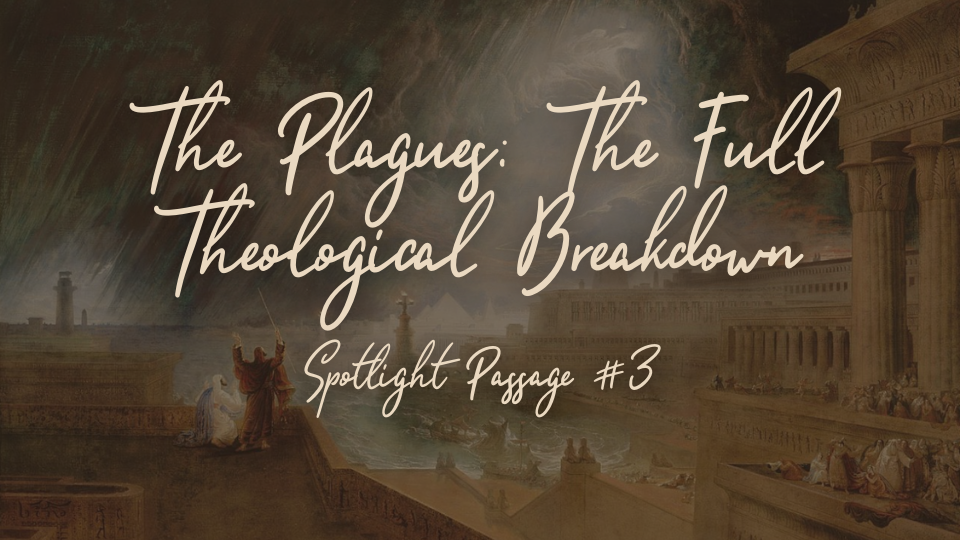
The Seventh Plague of Egypt" by John Martin (1823). Oil on canvas. Museum of Fine Arts, Boston (1982.559). Public Domain. (Text overlays mine)
Spotlight Passage 3: The Plagues: Full Theological Breakdown
Scripture Focus:
- Exodus 7-12 – Read all ten plagues in sequence
- Psalm 78:43-51 – Poetic retelling: "He sent swarms of flies that devoured them, and frogs that devastated them... He struck down every firstborn in Egypt."
- Exodus 12:12 – "On that night I will pass through Egypt and strike down every firstborn—both people and animals—and I will bring judgment on all the gods of Egypt. I am the LORD."
Historical Deep-Dive:
The ten plagues weren't random disasters. They were systematic theological warfare. Each plague targeted a specific Egyptian god or a core aspect of Ma'at. God wasn't just demonstrating raw power—He was dismantling Egypt's entire cosmology piece by piece, proving that the gods who claimed to maintain cosmic order couldn't even protect themselves.
Here's the full breakdown:
1. The Nile turned to blood (Exodus 7:14-24)
Target: Hapi, the god of the Nile
The Nile wasn't just a river. It was sacred, divine, the physical manifestation of Egypt's blessing. Hapi was depicted as a well-fed man with a ceremonial false beard, often shown carrying offerings of fish and waterfowl. The annual flooding of the Nile was attributed to Hapi's generosity. And God turned it to blood. Fish died. The water stank. Egyptians had to dig along the banks for drinking water. The very foundation of Egyptian civilization—the predictable, life-giving Nile—became a source of death.
2. Frogs (Exodus 8:1-15)
Target: Heqet, the frog-headed goddess of fertility and childbirth
Heqet was honored throughout Egypt. Frogs were symbols of life emerging from the Nile's waters. But God sent so many frogs that they invaded homes, bedrooms, ovens, kneading bowls. They were everywhere—underfoot, in food, in beds. What was once a symbol of blessing became a plague of suffocating abundance. And then they all died at once, rotting in heaps that filled Egypt with the stench of decay.
3. Gnats/Lice (Exodus 8:16-19)
Target: Priestly purity and the temple system
Some translations say lice or mosquitoes. Either way, this plague attacked the priests' ability to maintain ritual purity. Egyptian priests shaved their entire bodies and wore white linen to maintain ceremonial cleanliness. They couldn't perform temple duties if they were unclean. Gnats made cleanliness impossible. The priests—mediators between gods and humans, the ones who performed the daily rituals that kept Ma'at functioning—were rendered ceremonially impure. Temple rituals stopped. The machinery of Ma'at broke down.
4. Flies (Exodus 8:20-32)
Target: Egypt's territorial control and the distinction between sacred and profane
This plague distinguished between Egypt and Goshen. The flies swarmed over Egypt but avoided the Hebrews' land. This wasn't just random chaos—it was targeted judgment. God was making it clear: He could control where disaster struck and where it didn't. Egypt's gods couldn't even protect Egypt's own territory. The boundary between Egyptian land and Hebrew land mattered to YHWH—but Egypt's gods couldn't enforce any boundaries at all.
5. Livestock disease (Exodus 9:1-7)
Target: Hathor (the cow goddess) and Apis (the sacred bull)
Hathor was one of Egypt's most beloved goddesses—depicted with cow ears or as a full cow. She represented joy, motherhood, music, and fertility. Apis was a sacred bull worshiped as the living manifestation of Ptah (the creator god). Cattle weren't just economic assets—they were religiously significant, tied to divine power and blessing. The death of Egypt's livestock was both an economic catastrophe and a theological humiliation. The gods who were supposed to protect Egypt's herds were powerless. And again, the distinction was made: Hebrew livestock were unharmed.
6. Boils (Exodus 9:8-12)
Target: The magicians and Egypt's priestly class
This plague struck the magicians—the ones who had replicated some of Moses' earlier signs using their "secret arts" (Exodus 7:22, 8:7). Now they couldn't even stand before Pharaoh because of the painful sores covering their bodies. The religious professionals, the ones who claimed to mediate divine power and maintain Ma'at through ritual, were broken and humiliated. They couldn't help Pharaoh. They couldn't help Egypt. They couldn't even help themselves. This was a direct assault on Egypt's priestly infrastructure.
7. Hail (Exodus 9:13-35)
Target: Nut (sky goddess) and Shu (god of air)
Nut, the sky goddess, and Shu, the god of air, were supposed to maintain the separation between heaven and earth—the ordered cosmos. Hail—frozen water falling from the sky, mixed with fire (lightning)—violated that cosmic order. It destroyed crops, killed livestock and people caught outside, shattered trees. This wasn't normal weather. This was the heavens attacking the earth. And again, God distinguished between Egypt and Goshen. The Hebrews' land was untouched. Nut and Shu couldn't maintain the cosmic boundaries they were responsible for.
8. Locusts (Exodus 10:1-20)
Target: Egypt's agricultural gods and food security
This plague finished what the hail started. Locusts devoured every plant, every crop, everything green that had survived the hail. Egypt's food supply—managed so carefully through Joseph's bureaucratic genius centuries earlier, stored in massive granaries, distributed through temple networks—was obliterated. The economic engine of empire ground to a halt. Gods associated with agriculture and abundance (like Osiris, Nepri the grain god, and Renenutet the harvest goddess) were shown to be powerless. The gods who were supposed to ensure abundant harvests? Silent. Powerless.
9. Darkness (Exodus 10:21-29)
Target: Ra (or Amun-Ra), the sun god and supreme deity
This might be the most theologically devastating plague. Ra—the sun god, supreme deity, the one whose daily journey across the sky maintained cosmic order—was blotted out. For three days, Egypt was plunged into darkness so thick it could be felt (Exodus 10:21). The sun didn't just fail to shine. It disappeared. Ra's daily battle against Apep (the serpent of chaos)—the cosmic struggle that Egyptians believed happened every single night in the underworld—wasn't just lost. It didn't even happen. The very center of Egyptian theology collapsed. Pharaoh, who performed daily rituals to ensure the sun would rise, who claimed direct descent from Ra, couldn't bring back the light. And yet, the Hebrews had light in their dwellings (Exodus 10:23). YHWH controlled the sun. Ra did not.
10. Death of the firstborn (Exodus 11:1-12:30)
Target: Pharaoh himself as divine king and the entire theological cycle
This was the final, decisive blow. Every firstborn in Egypt died—from Pharaoh's heir to the firstborn of the slave girl grinding grain, to the firstborn of livestock. Pharaoh himself, the living god, the divine mediator, the incarnation of Horus, couldn't protect his own son. And this wasn't just personal tragedy. Pharaoh's firstborn was the future Horus, the next divine king who would maintain Ma'at when Pharaoh died and became Osiris. His death meant the cycle was broken. The theological system that had endured for millennia—the endless repetition of Osiris becoming Horus, Horus becoming Pharaoh, Pharaoh becoming Osiris—was shattered. The divine kingship that held Egypt's cosmos together was exposed as powerless. Meanwhile, the Hebrews who marked their doorposts with lamb's blood were passed over. God distinguished between His people and Egypt—not because the Hebrews were more righteous, but because of covenant faithfulness.
Reflect:
Read Exodus 12:12 again: "I will bring judgment on all the gods of Egypt. I am the LORD."
The plagues weren't random. They were systematic. Each one confronted a piece of Egypt's theological infrastructure. As you read through Exodus 7-12, ask yourself:
- Which Egyptian gods or aspects of Ma'at are being confronted in each plague?
- What would it have felt like to be an Egyptian watching your gods proven powerless, one by one?
- What would it have felt like to be a Hebrew watching the God you'd been told to trust finally act in undeniable power?
- How does this change the way you read the Exodus story? Is it just about physical liberation from slavery, or is it about something deeper—freedom from a theological system that made Egypt's power feel inevitable?
Where in your life do you need God to dismantle a system, structure, or "god" (lowercase-g) that promises security but ultimately can't deliver?
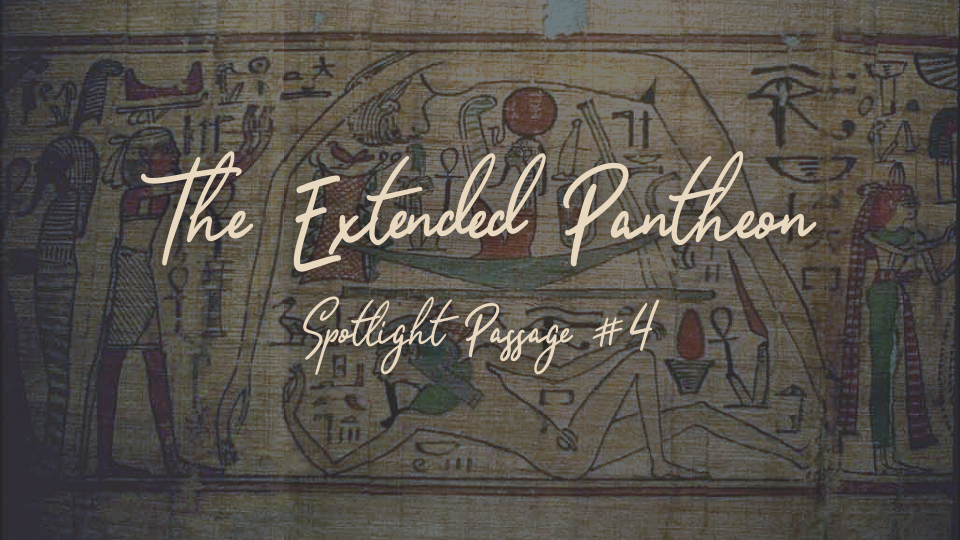
Egyptian cosmological scene: Nut (sky goddess) separated from Geb (earth god) by Shu (air god), with Ra's solar barque above. Painted papyrus detail, New Kingdom Egypt. Photograph used under Canva Pro license. (Text overlays and notations mine).
Spotlight Passage 4: The Extended Pantheon
Scripture Focus:
- Exodus 20:3-5 – "You shall have no other gods before me. You shall not make for yourself an image in the form of anything in heaven above or on the earth beneath."
- 2 Kings 17:29-33 – After Israel's exile: "Nevertheless, each national group made its own gods in the several towns where they settled."
- Acts 17:22-31 – Paul in Athens: "People of Athens! I see that in every way you are very religious... 'The God who made the world and everything in it is the Lord of heaven and earth.'"
Historical Deep-Dive:
We covered the major gods—Ra (Amun-Ra), Osiris, Isis, Horus—in the main article (or episode) because they formed the theological backbone of Egyptian kingship. But Egypt's pantheon was vast. Hundreds of gods, each with specific domains, specific temples, specific festivals, specific roles in maintaining Ma'at.
Here's a brief tour of the extended pantheon:
Thoth (ibis-headed or sometimes depicted as a baboon) was the god of wisdom, writing, and magic. Scribes—the literate elite who ran Egypt's bureaucracy—invoked Thoth before writing. He was also the divine recorder in the Hall of Judgment, writing down the results when hearts were weighed against Ma'at's feather. Thoth represented knowledge, precision, and the power of the written word.
Hathor (cow-eared, often depicted as the sky itself) was one of Egypt's most beloved goddesses. She represented joy, music, love, motherhood, and yes, drunkenness. Major festivals honored Hathor with music, dancing, and wine. She protected women in childbirth and was invoked for fertility and health. Hathor was everywhere—temples, amulets, household shrines. She was the divine mother who brought pleasure and abundance.
Anubis (jackal-headed) was the god who guided the dead through the underworld. He was the patron of embalmers and the one who weighed hearts in the Hall of Judgment (working alongside Thoth). Anubis represented the boundary between life and death, order and chaos. His role was to ensure safe passage—but only if you'd prepared correctly with the right rituals and spells.
Sekhmet (lioness-headed) was war and plague—both protector and destroyer. She was fierce, violent, unstoppable when unleashed. But she could also heal. Sekhmet represented the dual nature of power: it can save you or destroy you, depending on whether you're aligned with Ma'at. Pharaohs invoked Sekhmet before battle. Priests invoked her to ward off disease.
Ptah was the craftsman god, the patron of builders and artisans. Memphis (one of Egypt's capital cities) was Ptah's cult center. He was depicted as a mummified man holding a staff combining the ankh (life), was (power), and djed (stability). Ptah represented the creative power that built Egypt's temples, palaces, and monuments—the physical manifestation of Ma'at.
Sobek (crocodile-headed) ruled the Nile's waters and the marshlands. Crocodiles were both feared and revered in Egypt—dangerous predators but also symbols of Pharaoh's power. Sobek represented controlled chaos: the Nile's waters could bring life (flooding, fish, transportation) or death (drowning, crocodile attacks). Worshiping Sobek was about managing that danger.
And underneath the major gods were countless local deities, household gods, and protective spirits:
- Every nome (administrative district) had its patron god
- Every profession had its divine protector (e.g., Bes for households and childbirth, Taweret for pregnant women)
- Every major life event—birth, marriage, death, harvest, flood—required invoking the right gods with the right rituals at the right time
- Household shrines held images of protective deities
- Amulets depicting various gods were worn for protection, healing, or favor
This wasn't just religion, it was infrastructure. The gods weren't distant or abstract. They were embedded in daily life, in the rhythms of the calendar, in the functioning of the state. Priests managed temple economies—massive landholdings, grain storage, livestock, workshops. Temples employed thousands of people. Religious festivals weren't just spiritual observances—they were economic events, civic celebrations, demonstrations of Pharaoh's power and piety.
And all of it reinforced one central message: the gods are real, they are powerful, they have specific jobs, and if you honor them correctly, the cosmic machinery will keep running.
For the Hebrews watching from Goshen, this would have been overwhelming. Not just the theological claims, but the sheer number. Every natural phenomenon, every profession, every life stage, every fear or hope—Egypt had a god for it. And those gods seemed to work. The system delivered.
Reflect:
Read Exodus 20:3-5 again: "You shall have no other gods before me."
The sheer number of Egyptian gods would have made this commandment feel overwhelming. How do you honor just one God when everyone around you has a god for rain, a god for childbirth, a god for safe travel, a god for good harvests, a god for healing, a god for war, a god for writing, a god for death...?
But that's exactly the point. YHWH wasn't claiming to be the best god among many. He was claiming to be the only God. He wasn't just more powerful than Ra or Baal or Marduk. He was in a completely different category. They were created things (or human inventions). He was the Creator.
Look at Acts 17:22-31. Paul is in Athens—another city full of gods and shrines. He doesn't argue that the Greek gods are weak. He says they're not gods at all. "The God who made the world and everything in it is the Lord of heaven and earth and does not live in temples built by human hands" (v. 24). YHWH doesn't need temples, rituals, priests, or offerings to exist. He's not dependent on human worship. The gods are.
Here's the question: What's the difference between acknowledging that other nations worship other gods (which Scripture does—see 2 Kings 17:29-33, Psalm 96:5) and affirming that those gods are real and powerful?
Scripture takes a both/and approach: Yes, other nations worship other gods. No, those gods aren't real in the way YHWH is real. They're either human creations (idols carved from wood and stone) or spiritual forces (demons, fallen angels) masquerading as gods—but they're not sovereign, they're not creators, and they can't save.
So when Egypt's gods were dismantled by the plagues, it wasn't because YHWH was stronger in a power contest. It's because Egypt's gods were never actually in control of anything. They were part of a system—a brilliant, effective, impressive system—but ultimately a human system claiming divine authority.
Where in your life are you tempted to fragment your trust—putting faith in different "gods" (systems, people, strategies) for different areas of life, rather than trusting YHWH as the one sovereign Lord over everything?
Conclusion
If you found this Further Reading Plan helpful, let me know in the comments on Substack or over on social media! I'd love to hear how you're engaging with Scripture through this historical and anthropological lens.
Next week: Episode 4 explores Egypt's households and hierarchies—how Ma'at played out in daily life, family structures, and the brutal realities of slavery. We'll meet Shiphrah and Puah, the midwives who quietly resisted Pharaoh. See you then!