Part 2: The Machine of Egypt
Part 2: The Machine of Egypt
Pairs with: Part 2 of the Egypt and the Bible Series from You've Heard It Said: The Nile—Life, Death, and Control.
This "further reading" is designed to make your Bible reading come alive. There are no set days or obligations to read consecutively, so engage at your own pace. Some installments will be longer than others depending on the theme. The hope is that these curated spotlight passages will illuminate Egypt through the biblical lens, helping the stories you thought we knew take on new depth and meaning.
Key Idea
Egypt's stability came at a cost: total control. The Nile's predictability created abundance, but that abundance required an extractive, hyper-organized system of taxation, forced labor, and centralized power. This week's passages show us how that machine was built, how far Egypt's influence reached, and what happened when the Hebrews got caught inside it. Understanding how the system worked helps us see why people kept going there, and why it was so hard to leave.
Historical Context: Egypt's Economic Machine
Before we dive into the passages, let's ground ourselves in what made Egypt's economy work.
The Nile flooded predictably every year. That predictability allowed Egypt to develop sophisticated irrigation systems, accurate land surveys, and massive grain storage facilities. But all of this required something: control. Pharaoh's administration didn't just collect taxes, it orchestrated the entire agricultural cycle. Scribes tracked every bushel of grain. Surveyors measured land boundaries after each flood. Priests managed temple estates that functioned as economic centers. Corvée labor, forced work on state projects, built the temples, pyramids, and granaries that made Egypt legendary.
This wasn't just impressive organization. It was extraction. The state controlled the food supply, which meant it controlled the people. And when you control the food supply during a famine, you have absolute power.
Joseph understood this better than anyone. When he managed Egypt's seven-year famine, he didn't just store grain—he engineered a bureaucratic takeover that consolidated all land, livestock, and labor under Pharaoh's control. By the end, Egyptians were giving 20% of their harvest to Pharaoh in perpetuity (Genesis 47:26). The text doesn't celebrate this. It just reports it.
Egypt's economic machine worked. That's what made it seductive. And that's what made it dangerous.
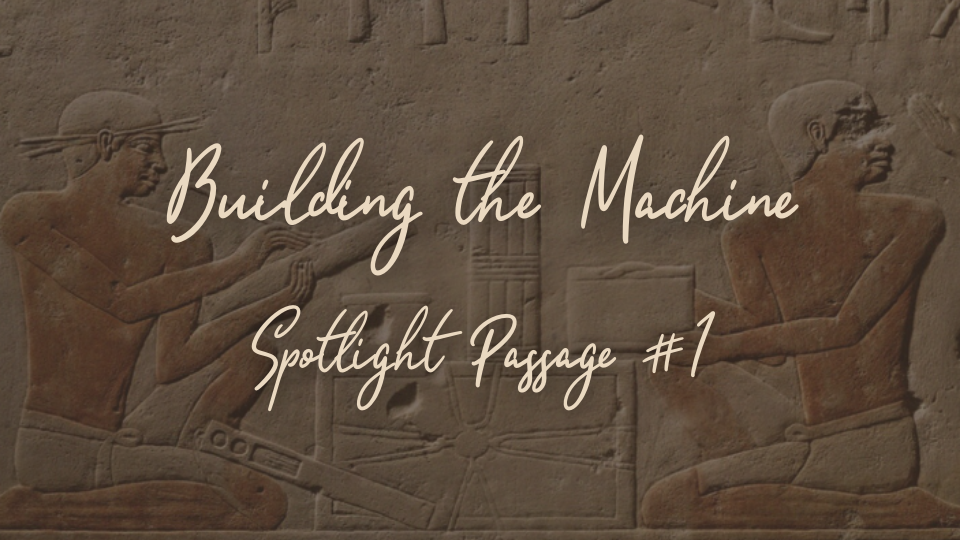
Two Scribes. Relief from the Mastaba of Akhethotep, Saqqara. Old Kingdom, 5th Dynasty (c. 2494–2345 BC). Collection of the Egyptian Museum, Cairo. Photo © Fine Art Images / Heritage Images / Getty Images. Text overlay mine.
Spotlight Passage 1: Building the Machine
Read: Genesis 47:13-26
This passage is complicated, isn't it?
Joseph—the hero of the Genesis story, the one who saved his family, the one who stayed faithful to God even in slavery and prison—is administering Egypt's famine response. And the result is total consolidation of power under Pharaoh.
The famine is severe. People run out of money, so they trade their livestock for grain. Then they run out of livestock, so they trade their land. Then they have nothing left but themselves, so they become servants to Pharaoh. By the end, all the land belongs to Pharaoh (except the priests' land—they're exempt, which tells you something about the power structure). The people are essentially sharecroppers on land they used to own, giving 20% of their harvest to the state forever.
But here's what one of my favorite commentaries, The Bible Knowledge Commentary (edited by John F. Walvoord and Roy B. Zuck), points out that we can't miss: "In selling food to the people during the famine that was severe, Joseph accepted money and livestock (horses...goats...cattle, and donkeys as payment), and finally the entire land of Egypt itself except the land of the priests." This commentary emphasizes Joseph’s role as administrator within Egypt’s existing system rather than architect of it.
And look at verse 27: "However, in the land of Goshen the Israelites prospered and multiplied greatly." While Egypt consolidated into centralized control, God's people flourished in the borderlands. Joseph's administration saved lives—including his own family's.
The text isn't celebrating Egypt's totalitarian turn. It's showing us the irony: the same efficient system that allowed Joseph to save his family during the famine would, generations later, make it possible for another Pharaoh to enslave them. Egypt's strength was also Egypt's danger.
Joseph was faithful within a foreign system. He used his position to save lives, to bless Egypt, and to preserve his family. But he couldn't change the fundamental nature of the system itself. And that system—hyper-organized, centrally controlled, extraction-based—would eventually turn on the very people it once saved.
Reflect:
- Joseph worked within Egypt’s system to save lives, but couldn’t change its fundamental nature. Where are you called to be faithful within systems you can’t fully control? What does that faithfulness look like?
- The Israelites prospered in Goshen even as Egypt centralized power. Where have you seen God provide for you even when larger systems feel oppressive or unjust?
- Joseph’s work had unintended consequences generations later. How does that reality shape the way you think about your own work and influence within institutions?
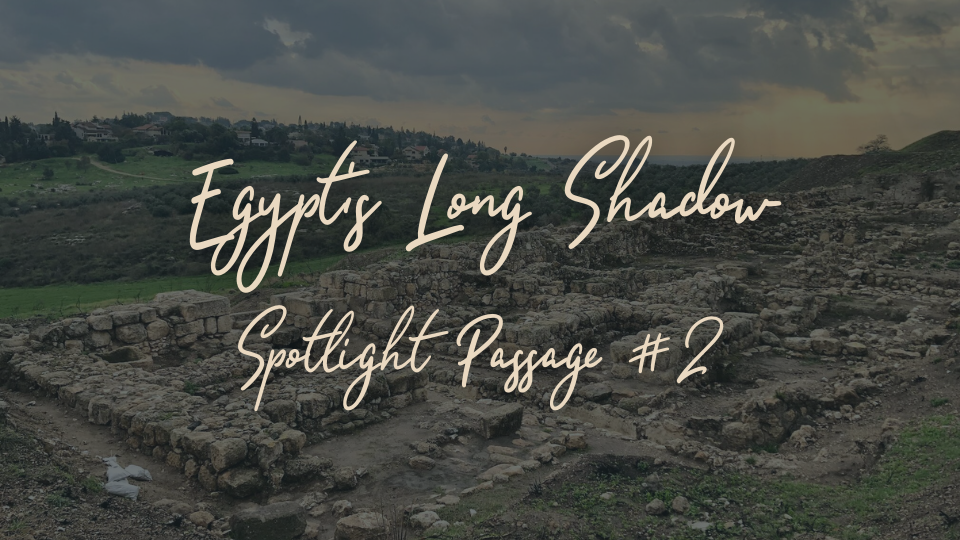
Archaeological remains of Gezer, an ancient fortified city in the southern Levant. Photograph; text overlay mine.
Spotlight Passage 2: Egypt's Long Shadow
Read: 1 Kings 3:1, 9:16, 10:28-29
Let's jump forward several centuries to Solomon's reign (around 970-930 BC).
By this point, Egypt's power has waned significantly. We're in the Third Intermediate Period—Egypt is fragmented, politically unstable, no longer the superpower it once was. And yet, Egypt still matters. A lot.
Solomon's first political move as king? Marry Pharaoh's daughter (1 Kings 3:1). And not his first wife—nor his first wife outside of the faith (Naamah the Ammonite was likely his fist wife, this is the mother of Rehoboam). This early political move was not a treaty with a neighboring kingdom. Not a military alliance with a rising power. But a move to align with Egypt. Even in decline, Egypt was still the name that mattered.
And look at what Pharaoh gives as a dowry: the city of Gezer. He captures it, burns it, kills the Canaanites living there, and hands it over to Solomon as a wedding gift (1 Kings 9:16). Think about that. A weakened, fragmented Egypt still has the military capacity to conquer a fortified city and give it away like a wedding present.
Then there's 1 Kings 10:28-29. Solomon imports horses and chariots from Egypt. Horses—Egypt's specialty, the ancient world's equivalent of tanks. And here's the kicker: Deuteronomy 17:16 explicitly warns that Israel's kings should NOT acquire horses from Egypt. It's one of the few specific "don'ts" for kingship. And Solomon does it anyway.
Why? Because Egypt was a machine. Egypt had what Israel needed—military technology, political prestige, economic stability. The temptation wasn't to trust in Egypt's gods. The temptation was to trust in Egypt's systems.
Egypt wasn't ancient history to Solomon. Egypt was his father-in-law. Egypt was in the room where it happened. And this is the pattern we see throughout Scripture: Egypt as the backup plan. The place you go when you need security. The ally you call when you're afraid. Even when God explicitly says, "Don't."
Reflect:
- Why do you think God warned Israel's kings not to acquire horses from Egypt specifically? What was the danger?
- Where do you rely on "Egypt's horses"—systems, strategies, or securities that feel more reliable than trusting God?
- Solomon had God's wisdom and still chose Egypt's horses. What does that tell us about how seductive pragmatism can be?
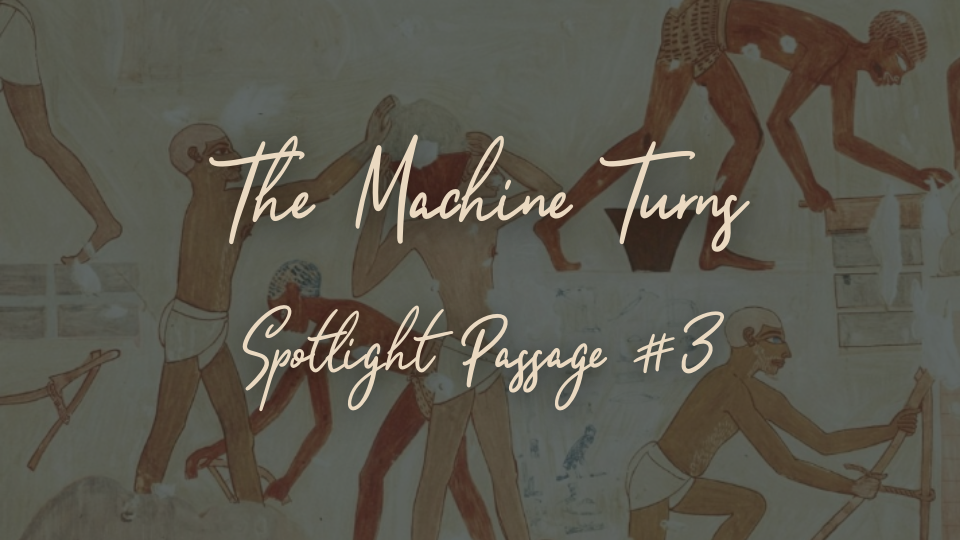
State laborers at work. Wall painting from the Tomb of Rekhmire (TT100), Valley of the Nobles, Thebes.
18th Dynasty (c. 1400 BC).
Photograph of wall painting; text overlay mine.
Spotlight Passage 3: The Machine Turns
Read: Exodus 1:8-14
"Now there arose a new king over Egypt, who did not know Joseph." Exodus 1:8
After spending fourteen memorable chapters with Joseph, you turn the page and read these words. This isn't amnesia. This is political erasure.
The new regime didn't want to remember what Joseph did. They didn't want to remember that the Hebrews saved Egypt during the famine, that Joseph was second-in-command, that this family had been invited guests. Frankly, the memory was inconvenient to the national pride of Egypt.
So the story gets rewritten: Hebrews went from "Joseph's family who saved Egypt" to "dangerous immigrants who threaten our security" (v. 9-10). Sound familiar?
And notice what happens next: forced labor. The same corvée system that built Egypt's temples and pyramids—the same system Joseph helped administer—now turns on the Hebrews. They're building Pithom and Raamses, storage cities for Pharaoh (v. 11). They're making bricks. They're being worked "ruthlessly" (v. 13-14).
The machine that saved them is now crushing them.
This is what extraction looks like when you're on the receiving end. When you're useful, you're tolerated. When you're perceived as a threat, you're enslaved. And the system that provided security for 400 years becomes the system of bondage.
Here's the sobering reality: Egypt didn't fundamentally change. The economic machine was always extractive. The Hebrews just switched from being inside the system to being exploited by it. The same granaries that stored Joseph's grain now store the grain the Hebrews are forced to produce.
And this is why the Exodus is so radical. God doesn't just liberate them from Pharaoh. He liberates them from the entire system—the system that felt safe, the system that worked, the system that everyone else in the ancient world was trying to get into.
Reflect:
- A new king arose who did not know Joseph." How have you seen institutions or systems "forget" the contributions of marginalized people?
- The Hebrews were caught in a system they didn't build but couldn't escape. Where do you see people trapped in systems that benefit some while extracting from others?
- Why is it significant that God liberates Israel from the whole system, not just from one bad Pharaoh?
Conclusion
In these three passages, we've traced the arc of Egypt's machine:
- Joseph built it—consolidating power, centralizing control, creating an extractive system that saved lives but demanded everything in return.
- Solomon relied on it—even when warned not to, even when God said "don't trust Egypt's horses," the pull of Egypt's stability was too strong.
- The Hebrews were crushed by it—the same system that welcomed them eventually enslaved them, because extraction doesn't care about loyalty. It only cares about control.
Egypt's machine worked. That's what made it so dangerous.
And here's the question this week leaves us with: What systems feel safer than faith? Where are you tempted to trust in what works rather than in what God promises?
Egypt had the Nile. Egypt had the granaries. Egypt had the chariots. Egypt had stability.
But stability without freedom is slavery.
And God was calling Israel to something different—not to a better machine, but to trust in a God who doesn't operate like a machine at all. A God who provides manna day by day, who leads with a pillar of cloud and fire, who doesn't promise efficiency but promises presence.
That's harder to trust. Because it doesn't look like control.
But maybe that's the point.
Where to Go from Here:
Sit with these passages. Notice where you instinctively reach for Egypt's solutions—the pragmatic choice, the efficient system, the backup plan that feels safer than faith.
And ask yourself: What would it look like to trust God instead of trusting the machine?