Part 1: Egypt of the Imagination
Part 1: Egypt of the Imagination
Pairs with Part 1 of the Egypt and the Bible Series from You've Heard It Said: The Egypt in Your Head (And Why It's Wrong).
This "further reading" is designed to make your Bible reading come alive. There are no set days or obligations to read consecutively, so engage at your own pace. Some installments will be longer than others depending on the theme. The hope is that these curated spotlight passages will illuminate Egypt through the biblical lens, helping the stories you thought you knew take on new depth and meaning.
Key Idea
Throughout Scripture, Egypt represents the place we run to when we're afraid—the place that works, that feels stable and reliable, but costs us something in return. These spotlight passages trace a pattern: from Abram's fearful flight to Egypt, to God stopping Isaac before he could repeat it, to the prophets warning Israel against political dependence on Egyptian power.
Historical Context: Egypt Across Israel's Story
Before we explore these passages, we need to understand something crucial: the Egypt in these texts isn't one Egypt—it's Egypt across centuries of shifting power, changing relationships, and evolving memory.
When Abram (remember, he's Abram at this point! Newly called by God, he had yet to step fully into the faith of God's promise) fled to Egypt during famine (likely sometime in the Middle Bronze Age, roughly 2000-1550 BC), he was walking into the heartland of Middle Kingdom Egypt. If we place Abram in a traditional second‑millennium setting, the royal center of Memphis becomes a possibility, or possibly another major city in the delta region of Lower Egypt, but the text does not specify. Either way, the Bible tells us he met with Pharaoh, so this was a seat of governmental authority. Egypt in the Middle Kingdom was a civilization at the height of its administrative sophistication and cultural confidence. Egypt wasn't just powerful; it was one of the defining centers of civilization in the ancient Near East. I would say "the defining center," but Mesopotamia might have something to say about that over in the Fertile Crescent. The Nile's predictable flooding made it the region's breadbasket, the place you went when rain-fed agriculture failed you. Pharaoh's court of Genesis 12 wasn't some distant rumor, it was a political reality that shaped everyone's calculations about survival and security. Abram's journey wasn't unusual; it was pragmatic. Egypt was where you went to live.
By Isaac's generation, that political scene hadn't changed much. Egypt remained the logical answer to famine, which makes God's command to Isaac, "do not go down to Egypt," all the more striking. Isaac surely would have grown up hearing his father's stories about Egyptian abundance, Pharaoh's notice of him and his uncle Lot, and the wealth they acquired there. Choosing to stay in Gerar, in Philistine territory, meant choosing scarcity over plenty, obscurity over the center of power. I will note here, that the Philistines of these early pages of Genesis do not appear to be the Philistines as you remember them from the Judges and early monarchy days of Israel. They weren't occupying the land until around 1200 BC (we infer this in part from Ramesses III’s inscriptions and from archaeology). These Philistines may have been part of the Sea Peoples who settled in the area—archaeology shows five cities along the southern Canaanite coast were populated by similar groups around this time.
Fast forward to Isaiah's time (8th century BC), and Egypt's role in Israel's world had shifted dramatically. This is the era of the Neo-Assyrian Empire's expansion, and Egypt—still significant, still powerful—had become a potential (but unreliable) ally against the Assyrian threat. Egyptian diplomacy mattered. Egyptian military support was something kingdoms sought. But Egypt was also notorious for promising help and failing to deliver. Why leave the safety of their River Valley home if they don't need to? And they certainly had matters at home to attend to. This was the late Third Intermediate Period, when Egypt was politically fragmented and overshadowed by the rising Assyrian Empire, and Kushite rulers from the south were asserting control over Egypt. When Isaiah prophesies about Egypt becoming "my people" alongside Israel and Assyria, he's speaking into a world where Egypt represents both political calculation and past oppression—a complex, layered symbol.
By the time Psalm 105 was sung in temple worship (likely compiled during or after the exile in Babylon, 6th century BC), Egypt had transformed again—this time into sacred memory. The Egypt of the Psalmist isn't a contemporary political threat or potential ally. It's the backdrop of Israel's origin story, the place where "they" became "we," where slavery became the defining experience that the Hebrews collectively remembered. Egypt had become less about geography and more about theology—the place God delivered them from, the measuring stick for all future deliverance. After experiencing Babylonian exile, Israel's poets looked back to Egypt and saw a pattern: God had delivered them from one empire, and He could deliver them from another.
What matters for our reading:
Each of these authors is responding to a different Egypt. Abram navigates Egypt as superpower. Isaac resists Egypt as temptation. Isaiah reimagines Egypt as future family. The Psalmist remembers Egypt as sacred story. Same civilization, different moments, different meanings. As you read these passages this week, pay attention to how Egypt shifts—and what that teaches us about how God's people learned to see the empires around them.
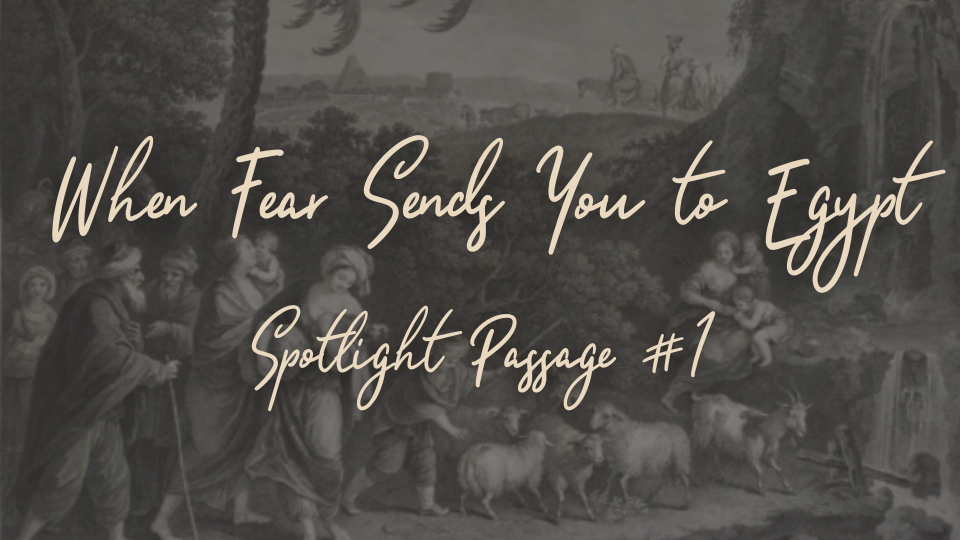
The Departure of Abraham and Lot from Egypt. Engraving by Francesco Bartolozzi and William Byrne after Francesco Zuccarelli, 18th century. Public domain. Text overlay mine.
Spotlight Passage 1: When Fear Sends You to Egypt
Read: Genesis 12:10-20
There was a famine in the land, so Abram went down to Egypt.
Sounds reasonable, right? Famine hits Canaan, Egypt has food, so you go where the food is. Except Abram had just received the most extraordinary promise from God just ten verses earlier (vv.1-3): land, descendants, blessing for all nations. And the moment things got hard, he ran to Egypt.
The narrative doesn’t explicitly condemn the decision to go to Egypt, but it shows how fear led Abram into compromise. Egypt didn't force Abram to come. He chose it. Because Egypt worked. It had infrastructure, grain storage, predictable flooding from the Nile. Egypt was the ancient world's insurance policy.
But notice what happens the moment Abram crosses the border: he lies. He tells Sarai to say she's his sister because he's afraid Pharaoh will kill him to take her. The place that was supposed to save him becomes the place where he compromises his integrity—and puts his wife in danger.
Abram gets wealth in Egypt (livestock, servants, gold), but he also gets entangled. He leaves richer and more fearful. And he brings an Egyptian servant named Hagar home with him—a decision that affects the trajectory of this family's history in significant ways for generations.
Egypt saved Abram from starvation. But it cost him something too.
Reflect:
- Like Abram turned to Egypt when life got hard, what places or systems that feel stable and reliable but might cost you your integrity?
- Have you ever made a choice out of fear that seemed practical at the time but led you into compromise?
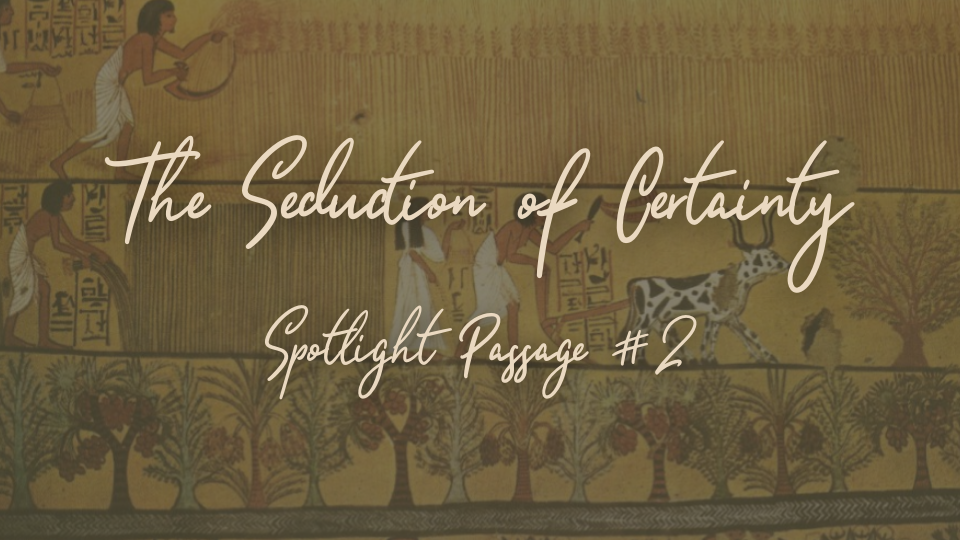
Agricultural scenes in the Fields of Iaru. Wall painting from the Tomb of Sennedjem, Deir el-Medina.
New Kingdom, 19th Dynasty.
Photograph of wall painting; text overlay mine.
Spotlight Passage 2: The Seduction of Certainty
Read: Genesis 26:1-6
Feeling like déjà vu? Here's another famine in the land, but this time, Isaac went to Abimelek king of the Philistines in Gerar. The LORD appeared to Isaac and said, "Do not go down to Egypt; live in the land where I tell you to live."
This is fascinating. Isaac faces the same situation his father did: famine, fear, the temptation to flee to Egypt. But this time God stops him at the border and says, "Don't go."
Isaac's father went to Egypt and came back compromised. His grandfather Abraham started a pattern: when things get hard, trust in Egypt's systems instead of God's promises. God is breaking the cycle before Isaac can repeat it.
Notice God doesn't just say "don't go"—He gives Isaac an alternative: "Live in the land where I tell you to live. Stay in Gerar, stay in the famine, and I will be with you."
God doesn't always rescue us from hard circumstances. Sometimes He meets us in them. Sometimes the wilderness is where we learn to trust Him instead of trusting the machinery of empire.
Isaac stays. And God provides.
Reflect:
- When has God asked you to stay in a hard place instead of running to the "logical" solution?
- What's the difference between wise planning and trusting in systems/structures more than you trust God?
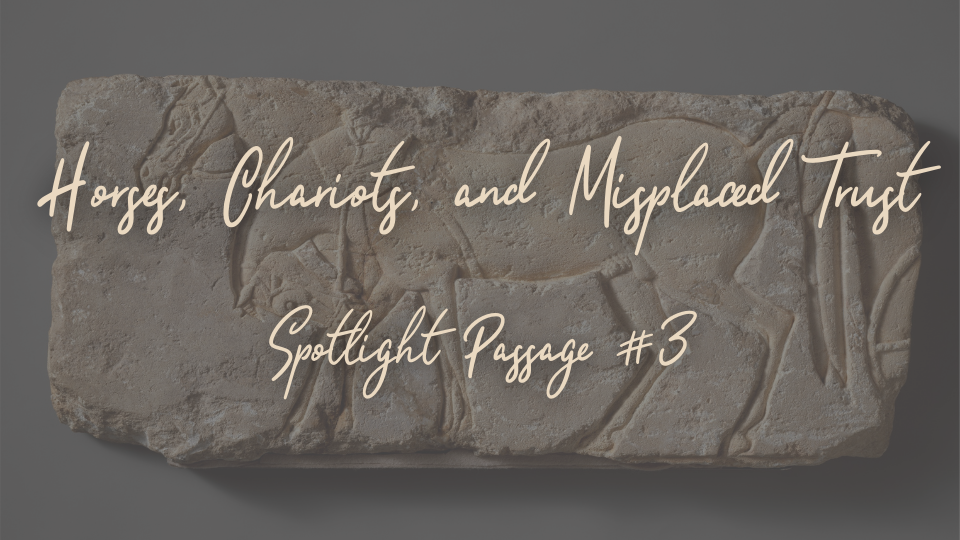
Horses Harnessed to a Chariot. New Kingdom, Amarna Period (c. 1353–1336 BC). The Metropolitan Museum of Art, New York. Photograph of museum object; text overlay mine.
Spotlight Passage 3: Horses, Chariots, and Misplaced Trust
Read: Isaiah 30:1-7
"Woe to those who go down to Egypt for help and rely on horses, who trust in chariots because they are many and in horsemen because they are very strong, but do not look to the Holy One of Israel or consult the Lord!" Isaiah 31:1, ESV
I had to include that second Isaiah verse above because it just doubles down on this point in a really effective way. I hope you don't mind! By Isaiah's time (700s BC), Egypt had become Israel's go-to political ally whenever they felt threatened. Assyria breathing down their neck? Better make a treaty with Egypt. Babylon rising in the east? Egypt's got chariots and cavalry.
But Isaiah sees through it. Egypt's power is impressive—horses, chariots, professional armies—but it's hollow. Egypt looks strong, but it's "Rahab the Do-Nothing" (v. 7). In case you're unfamiliar, this is not the woman named Rahab found in the book of Joshua/of Davidic line fame. This is a reference to a mythical sea monster from ancient Near Eastern literature—a chaos creature representing forces of disorder that God subdued at creation. Isaiah is using poetic wordplay here: Egypt, which sees itself as the embodiment of cosmic order and power, is impressive-looking but ultimately powerless before the true God. All show, no substance.
Here's the thing: Isaiah isn't saying Egypt is evil. He's saying Egypt is not God. Trusting in Egypt's military might is just another form of idolatry—putting your hope in created things instead of the Creator.
Israel keeps going back to Egypt (literally and metaphorically) because Egypt feels safer than faith. You can see chariots. You can count horses. You can sign treaties with Pharaoh. Faith in an invisible God who makes promises? That feels riskier.
But Isaiah's warning stands: Egypt will fail you. Not because Egypt is the villain—but because Egypt is finite, human, fragile. Only God endures.
Reflect:
- What are the "horses and chariots" in your life—things that feel more tangible and reliable than trusting God?
- Why is it often easier to trust what we can see and measure than to trust God's promises?
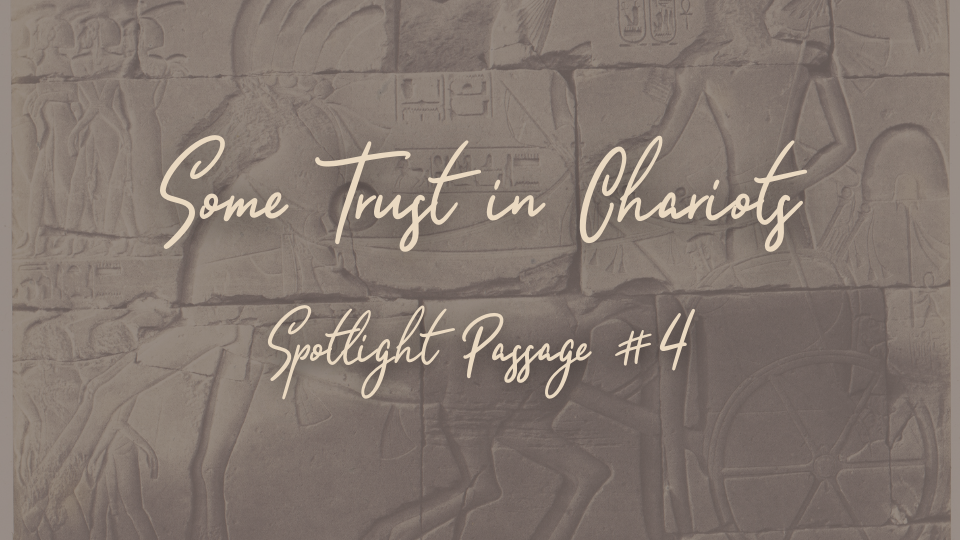
Pharaoh Seti I in battle. Relief from the north exterior wall of the Great Hypostyle Hall, Karnak Temple, Egypt. 19th Dynasty. Photograph of relief; text overlay mine.
Spotlight Passage 4: Some Trust in Chariots
Read: Psalm 20:7-9
This psalm is short, but it captures everything.
Chariots and horses—Egypt's specialty, the ancient world's equivalent of tanks and fighter jets. They're the ultimate symbol of military security. The thing that makes you feel safe.
But the psalmist says: we don't trust in that. We trust in the name of the LORD. In His name—His character, His reputation, who He has revealed Himself to be.
Egypt's chariots rust. Egypt's horses die. Egypt's empire—no matter how permanent it seemed—eventually fell. But God's name endures.
This is the choice Israel had to make over and over again: Will we trust in what looks powerful, or in the God who is powerful?
And here's the uncomfortable part: sometimes trusting God means standing in a famine and waiting. Sometimes it means watching Egypt's chariots roll by and choosing not to call for backup. Sometimes it means looking weak, vulnerable, foolish, because that's what faith looks like from the outside. But the real ones know.
And so the psalmist's promise stands: "They are brought to their knees and fall, but we rise up and stand firm."
Egypt's power is temporary. God's is not.
Reflect:
- In what areas of your life are you tempted to "trust in chariots"—to rely on your own strength, systems, or strategies instead of God?
- What would it look like to trust in the name of the LORD in that situation instead?
"Moses and Aaron before Pharaoh." From Dalziels' Bible Gallery. The British Museum. © The Trustees of the British Museum, CC BY-NC-SA 4.0. Text overlays and notations mine.
Conclusion
In this first part, we've traced a pattern across Scripture:
- Abram went to Egypt out of fear and came back compromised.
- Isaac was told by God not to go—breaking the cycle before it could repeat.
- Isaiah warned Israel to stop running to Egypt for political security.
- The psalmist contrasted Egypt's chariots with trust in God's name.
Egypt keeps showing up as the place we go when we're afraid. The place that works. The place with systems, structures, certainty. The place that feels safer than faith.
But here's the tension: Egypt isn't always wrong. Sometimes it's just not enough. God doesn't condemn Egypt for being Egypt—He warns His people about making Egypt into their savior.
The question this week leaves us with is this: What are you trusting in when you're afraid? Not what you say you trust. Not what you wish you trusted. But when the famine comes—when life gets hard, when you feel vulnerable, when you need security—where do you actually turn?
Egypt saved Israel. Egypt enslaved Israel. And throughout Scripture, Egypt becomes the test: Will you trust in what looks powerful, or in the God who is powerful?
Where to Go from Here:
Where is God asking you to stay instead of run? Where is He inviting you to trust His name instead of relying on "chariots and horses"?
Take some time to sit with that question. Journal, pray, or simply notice where your instinct is to run to "Egypt"—whatever that looks like in your life.